

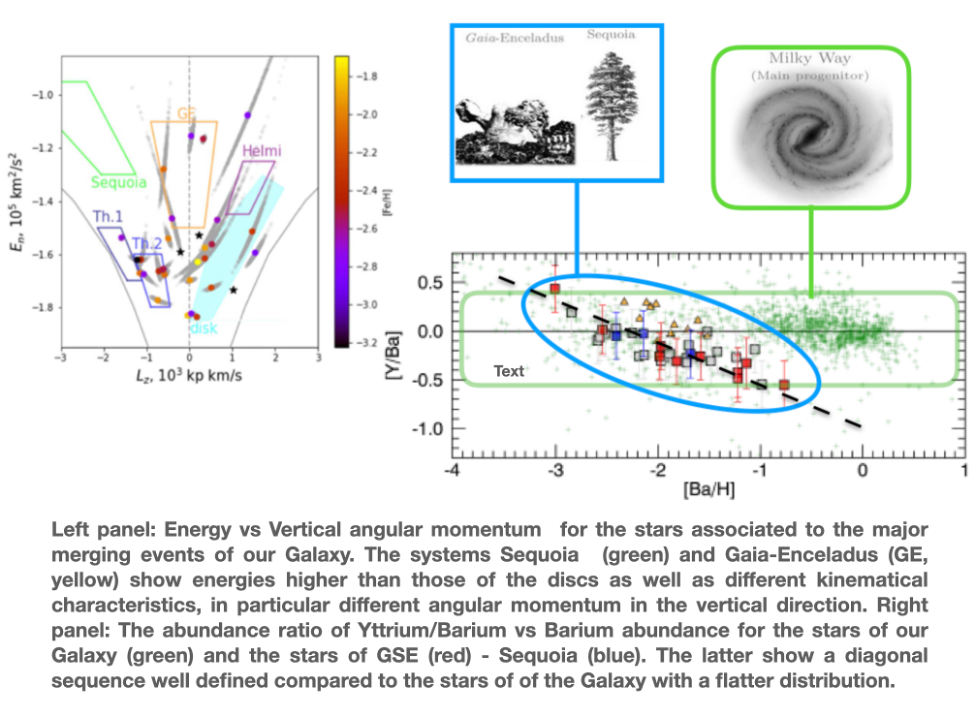
We have yet to find evidence of the existence of living alien beings but, thanks to our work recently accepted by the journal Astronomy and Astrophysics (François et al. 2024), we have very compelling evidence of the presence of alien stars in our Galaxy. These stars, indeed, were born in a completely different environment and later incorporated into the halo of the Galaxy through merging (i.e., collision with and subsequent absorption of the systems containing these stars). The data from which this research started were taken from the international survey MINCE (Measuring at Intermediate Metallicity Neutron Capture Elements), whose principal investigator (G. Cescutti) and many collaborators work at the Trieste Observatory. The figure illustrates some characteristics of this event.
The left panel shows a graph of energy versus angular momentum along the z direction (perpendicular to the galactic disk) of various stellar components of the Galactic halo, information obtained through the Gaia satellite. The graph shows that the stars from two systems in particular, Sequoia and Gaia-Enceladus (GSE), exhibit energy and angular momentum significantly different from stars in the Galactic disk. By itself, this graph demonstrates that the stars of Sequoia and GSE behave kinematically differently from those of the Galaxy disk and other systems, but alone it is not a "record" of the history of these systems, nor proof that they are alien in the sense of being formed in a different environment from the Milky Way.
The right graph is the main result of our study and represents a distribution of the yttrium/barium chemical abundance ratios as a function of barium/hydrogen for stars in the Milky Way (in green) and forstars from Sequoia and GSE (in blue and red, respectively). In this graph, the abundance ratios reveal the chemical composition of the interstellar medium at the time the stars formed, making this graph a "cosmic clock" that allows us to travel back in time and determine thephysical conditions of the environment in which the stars formed. The x-axis of this graph is like a clock, where [Ba/H]=0 represents the present moment while lower values represent past phases. As seen, the stars of Sequoia and GSE form a distinctly diagonal sequence compared to that of the Milky Way (horizontal line). The fact that the [Y/Ba] ratio at the time of the formation of GSE and Sequoia stars was much lower indicates that the star formation process was significantly different from that of the Milky Way. Indeed, it proves that the environment in which this formation occurred had different physical conditions, particularly a different star formation rate.
This graph allows us to make an important distinction between stars born in-situ, meaning within the Galaxy, and stars born ex-situ, outside of it and subsequently accreted through merging events. While some abundance ratios of certain systems like Enceladus were already known, our findings provide a crucial, definitive, and independent confirmation of the different origin of these stars. These stars represent true cosmic relics of a shipwreck, occurring when the galaxies hosting them were devoured by the Mare Magnum of the Milky Way halo, and they manifest their genetic diversities exclusively through different chemical abundance ratios.
ArXiv: https://arxiv.org/pdf/2404.08418.pdf
DOI: 10.48550/arXiv.2404.08418
