
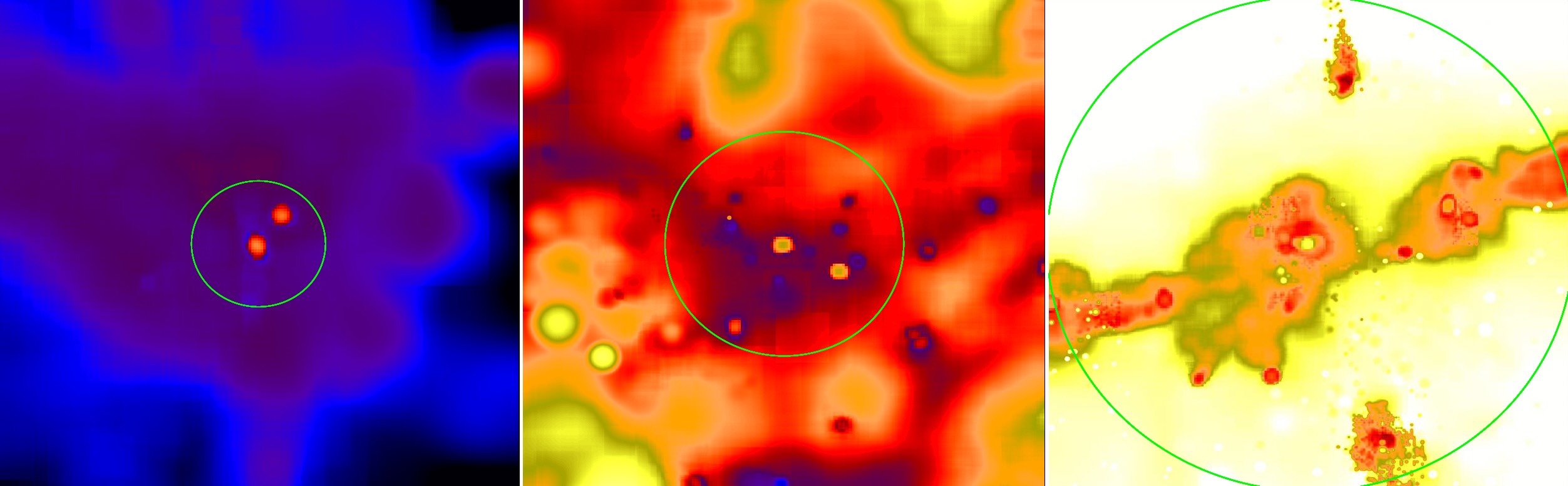
 The different phases of cosmic gas in galaxies — cold, warm, and hot — are closely linked to the underlying stellar populations and can help astronomers infer otherwise unknown properties. This emerges from a recent study by Italian astrophysicist Umberto Maio (INAF-Trieste) and his French collaborator Céline Péroux (ESO-Germany), “The baryon budget of galaxies across the first billion years”, accepted for publication in Astronomy & Astrophysics. Using detailed cosmological simulations, the researchers investigated the properties of cold, warm, and hot cosmic gas, offering a fresh perspective on the physical connections among these galaxy building blocks during cosmic evolution. The study highlights how molecular gas cooling fuels star formation, while stellar activity heats star-forming regions and replenishes the surroundings with new warm gas, as quantified by the time-dependent stellar return fraction. The findings show that the masses of HI and H2 gas increase with stellar mass and star formation rate, while their depletion times decrease to just 0.01–0.1 Gyr, with only a weak dependence on metallicity. “This has profound implications for the formation of galaxies similar to the Milky Way in ancient epochs and explains why star formation efficiency remains at a few percent independently of time,” comments Dr. Maio, lead author of the study. The team compared their theoretical results with observational data from ALMA, VLA, and IRAM, among the most advanced facilities in the world. These findings provide the physical basis to interpret primordial-galaxy detections in current and future observations and advance our understanding of cosmic structures across different cosmological epochs.

For the public
Contacts
INAF-Astronomical Observatory of Trieste
Via G.B. Tiepolo, 11 I-34143 Trieste, Italy
Tel. +39 040 3199 111
info.oats@inaf.it
C.F. 97220210583