
The European Euclid mission has published its first major astronomical catalogue, containing almost a billion galaxies and 160 million spectra, laying the foundations for the largest 3D map of the Universe with the vital contribution of the Trieste Astronomical Observatory, the Physics Department at the University of Trieste, and the SISSA.
 12 November 2026 – The first major data release from the European Space Agency (ESA)'s Euclid space mission has been published, with a significant contribution from Italy through the Italian Space Agency (ASI), the National Institute for AstroPhysics (INAF), the National Institute for Nuclear Physics (INFN) and several Italian universities. Nine hundred million galaxies, catalogued through ten thousand images covering 1,900 square degrees of sky, equivalent to the area of 9,500 full Moons. This is the Data Release 1 – Foundation, an imposing catalogue that also contains fifteen thousand potential gravitational lenses and sixty million quasars, and includes spectroscopic data for 160 million sources: it is the first step towards building the largest 3D map of the Universe ever made.
Euclid, launched in 2023, aims to map a third of the celestial sphere, observing billions of galaxies to investigate the history of the Universe and uncover the mysteries of its most enigmatic components: dark matter and dark energy. The data made public today, based on 13 months of observations, around ten years of algorithm development and a year of processing and analysis, represent only 14% of the census of the sky that Euclid will carry out over six years. They are the first pieces of the majestic three-dimensional map of the cosmos that researchers are eagerly awaiting in order to begin unveiling the mysteries of the dark universe.
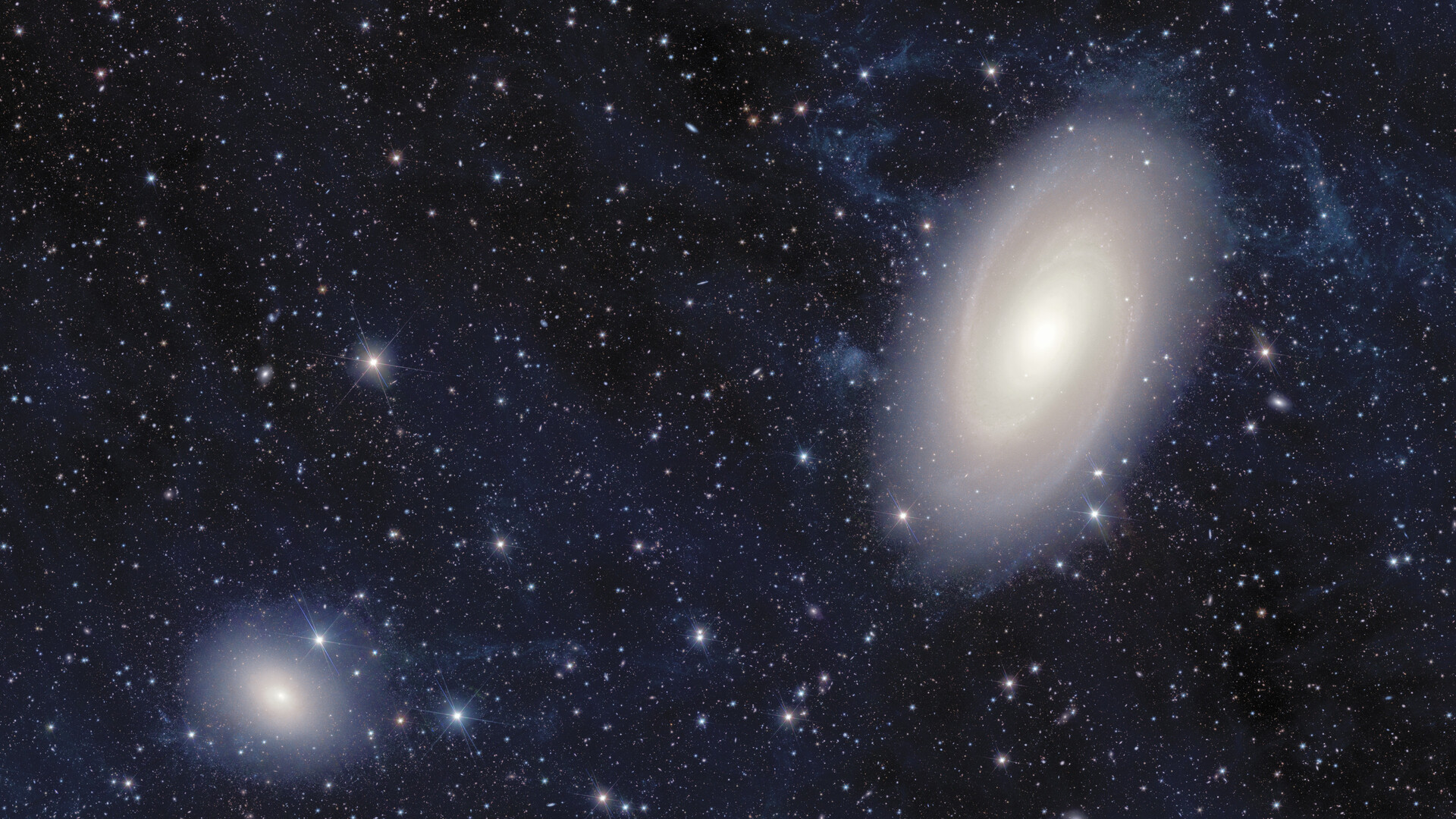
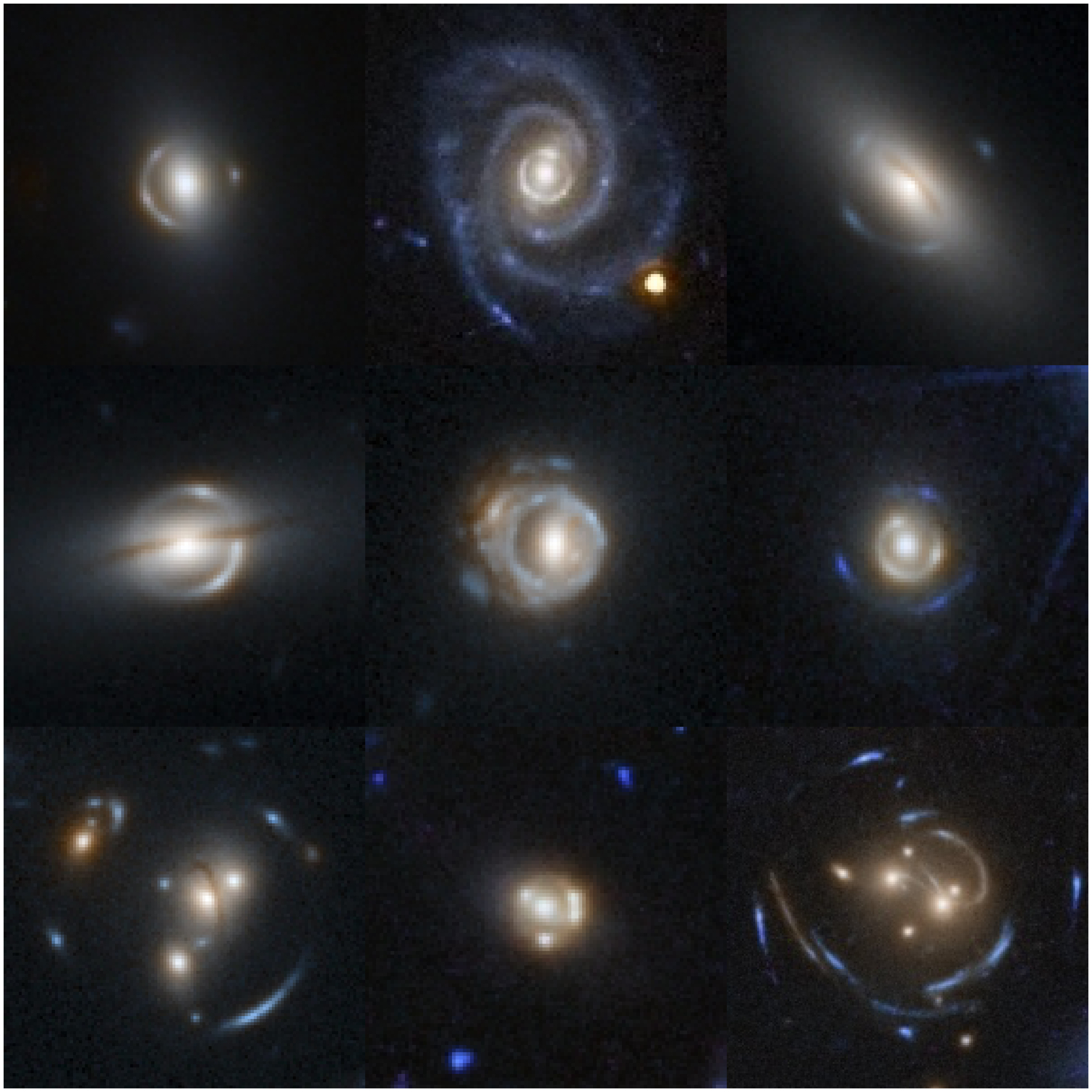
The new catalogue includes a vast sample of galaxy groups and clusters, the largest structures in the Universe held together by mutual gravitational attraction, which make it possible to examine the formation history of the structures populating today's cosmos. Two splendid examples are the Horologium Supercluster and several galaxies belonging to the M81 group, captured in the images accompanying the release. It also includes 15,000 strong gravitational lenses: galaxies which, thanks to a fortuitous cosmic alignment, produce spectacular images of even more distant galaxies, appearing as arcs or rings of light.
Credits: ESA/Euclid/Euclid Consortium/NASA
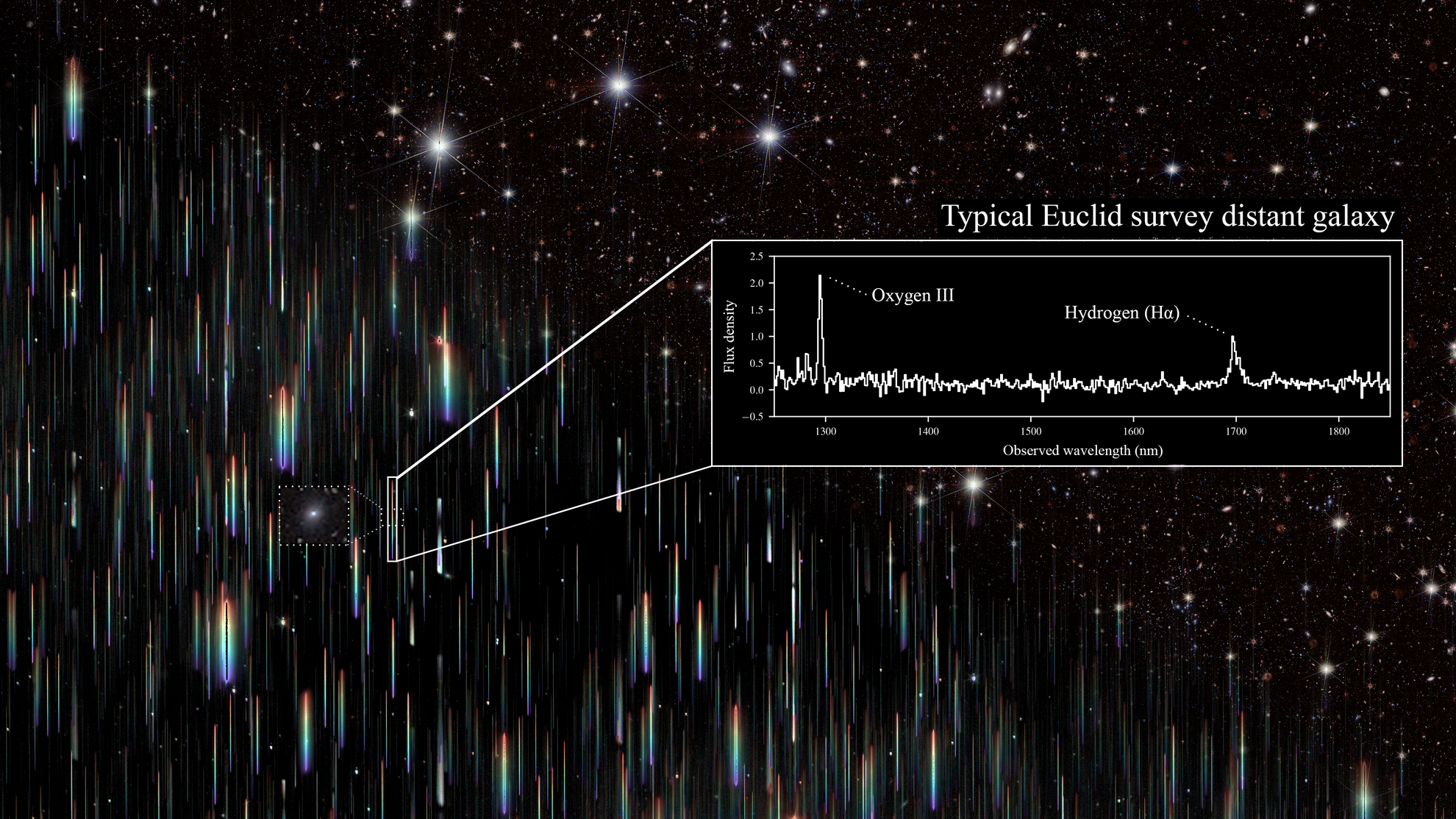
The Data Release 1 – Foundation covers a portion of the sky thirty times larger than the previous Euclid release, made public last year. In addition to the images captured by the two onboard instruments, VIS (VISible Instrument) and NISP (Near Infrared Spectrometer Photometer), it also includes spectroscopic data obtained with NISP for 160 million sources. «Extracting calibrated spectra from such a vast volume of data required the team at the Italian Science Data Centre to carry out complex work designing and optimising the analysis software for the NISP instrument, adapting it to the distributed computing infrastructure of the Science Ground Segment,» says Marco Frailis, the centre's manager. A spectrum, obtained by splitting light into its constituent colours, is a sort of barcode for galaxies: it contains valuable information about their physical properties (for example, their age and metallicity) and allows their distance to be estimated. This is why galaxy spectra are essential for turning Euclid's celestial atlas into the three-dimensional map of the cosmos needed to investigate the nature of dark matter and dark energy.
Credits: ESA/Euclid/Euclid Consortium/NASA
The mission is one of the most ambitious international programmes, in which Italy, through ASI, INAF and INFN, plays a leading role, involving hundreds of Italian scientists, including many from universities: the University of Bologna, the University of Milan (Statale), the University of Genoa, the University of Trieste, the SISSA, the University of Ferrara, the University of Turin, and the CISAS at the University of Padua.
Italy leads Euclid's Science Ground Segment, that is, the complex chain responsible for verifying the performance of the instruments in orbit and reducing the data received from the satellite, producing the images and spectra needed for scientific analysis, such as those made available in today's release. Andrea Zacchei, of the Trieste Astronomical Observatory, leads the Project Office together with Oriana Mansutti.
Italy also contributed to the construction of the two scientific instruments, VIS and NISP, designed the mission's observing strategy and hosts one of the nine Science Data Centres. The coordination of the teams operating the two instruments is led by Anna Gregorio of the University of Trieste and Roberta Giusteri of the Trieste Astronomical Observatory, and the Italian Science Data Centre is coordinated and managed by Marco Frailis, who is also from the Trieste Observatory: «The Science Data Centres are responsible for producing the data analysis software, which includes the design, development, integration and testing phases, before it is delivered to the team responsible for operations on the distributed infrastructure. In particular, the software dedicated to NISP data was developed in Trieste, both for the infrared imaging, which I coordinate, and for the spectroscopic imaging, under the leadership of Daniele Tavagnacco. The software that combines Euclid data with those from large ground-based telescopes is also developed and coordinated in Trieste, in this case by Samuele Galeotta and Erik Romelli of the Observatory.»
As regards the computing infrastructure, Marco Frailis adds: «The Italian Science Data Centre's infrastructure is distributed across two sites: at the Trieste Astronomical Observatory, which has 40 computing nodes, 1,400 cores and 650 terabytes of storage, and at the ALTEC (Aerospace Logistics Technology Engineering Company) in Turin, which has 3,600 cores and 11,000 terabytes (11 petabytes) of storage. These resources make up 25% of all the computational resources of the Euclid mission (placing Italy, together with France, in first place for contribution to the mission). They are distributed between Europe and USA and work in parallel as a single infrastructure, meeting the challenge of processing catalogues of a size and quality never before achieved by any mission.»
Around the middle of 2027, the Euclid mission will publish the full version of the Data Release 1, which will enrich the one released today with a series of additional information allowing us to calculate how each galaxy or galaxy cluster fits into the vast network of cosmic structures that permeates the Universe. It will also contain measurements of the gravitational lensing effect in its 'weak' form, that is, the slight distortion in the observed shape of galaxies caused by the large-scale distribution of matter in the Universe, a crucial element for studying in detail the effects of dark matter and dark energy.
The Trieste Astronomical Observatory, the University of Trieste and the SISSA will also play leading roles in this upcoming release, taking part, with Andrea Biviano, Marisa Girardi, Emiliano Munari, Federico Rizzo and Alex Saro, in the development of the software that extracts cosmological information from the images, and, with the groups led by Stefano Borgani, Matteo Costanzi, Gabriella De Lucia, Pierluigi Monaco and Emiliano Sefusatti, in the interpretation of the data and its comparison with cosmological theories.
These important results would not have been possible without the valuable contribution of the scientists and technologists on temporary contracts Michel Aguena da Silva, Lucie Baumont, Mohamed Yousry Elkhashab, Alessandra Fumagalli, Zohreh Ghaffari, Roberta Giusteri, Marius Lepinzan, Chiara Moretti, Federico Rizzo, Erik Romelli, Elena Sarpa, Antonino Troja, Thomas Vassallo and Daria Zakharova.
FOR FURTHER INFORMATION
Euclid is a European Space Agency (ESA) mission. Italy is one of the leading players, thanks to the support of the Italian Space Agency (ASI), the National Institute for AstroPhysics (INAF), the National Institute for Nuclear Physics (INFN) and numerous Italian Universities.
Link to the ESA Data Release 1 – Foundation: cosmos.esa.int/web/euclid/data-release-dr1
Image credits: ESA/Euclid/Euclid Consortium/NASA
