
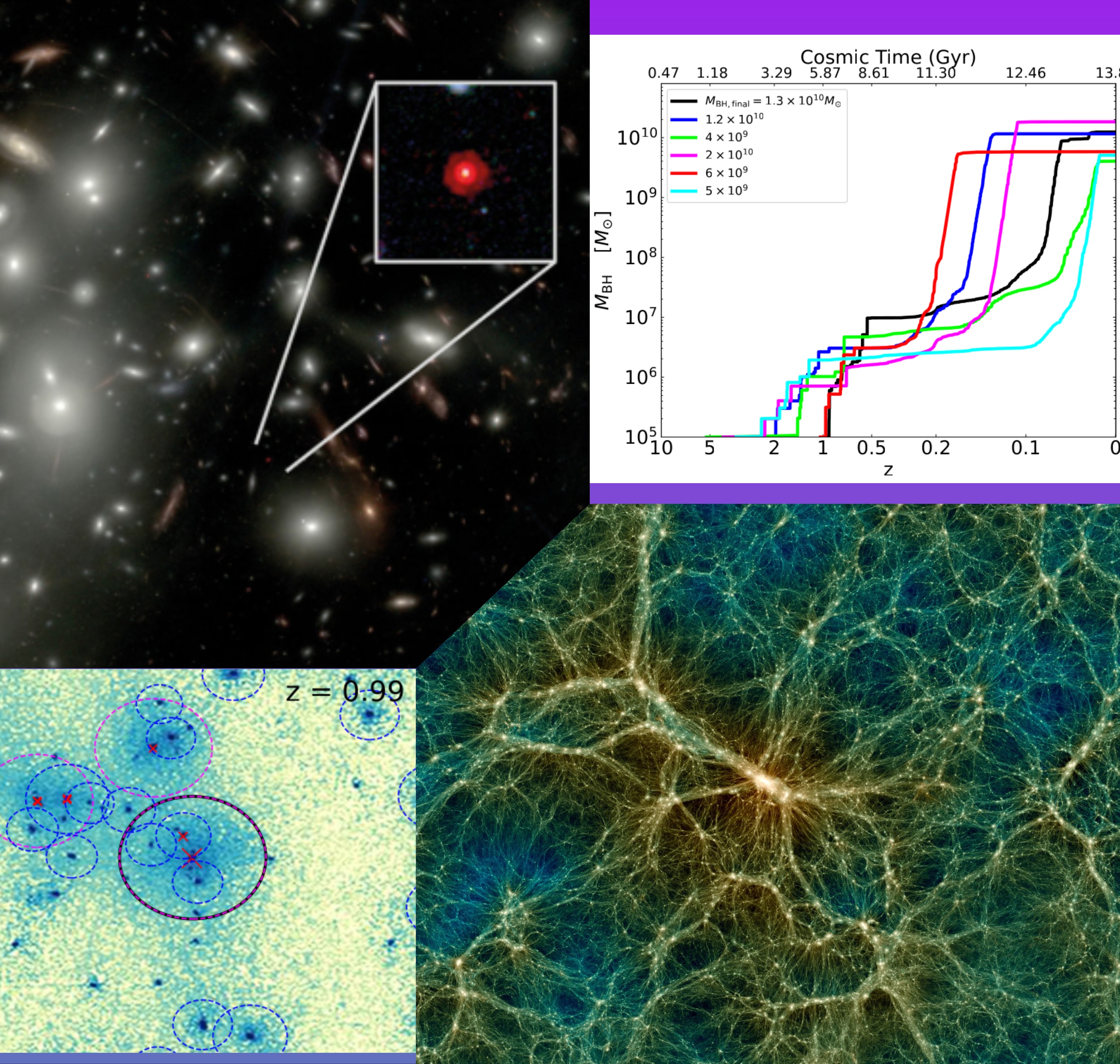
 Gigantic black holes reside at the centers of many massive galaxies. Physical reactions in the extreme gravity around a massive black hole create immense radiation being emitted from the central region of such a galaxy outshining all the stars in the whole galaxy. This special astronomical object is called an Active Galactic Nucleus (AGN). The black hole powering an AGN is monstrous in size, weighing more than a million times the Sun. Many such colossal black holes have been detected by astronomers, and they are called Supermassive Black Holes; some of which can be as heavy as a few billion times the Sun. But how did these black holes become so enormous? This question points to one of the biggest unsolved puzzles in astrophysics.
A recent study by Paramita Barai, Researcher at the INAF-OATs, has tried to shed light on the cosmic mystery of how black holes grow to become supermassive. Published in the international scientific journal Astronomy & Astrophysics, the study's methodology has been by performing huge numerical simulations executed on large supercomputers. The simulations begin from the primordial density fluctuations in the early Universe soon after the Big Bang, and use the laws of physics to calculate how dark matter and baryons evolve over 13.8 billion-years age of the Universe. These Cosmological Hydrodynamical Simulations (as called by astronomers) were analyzed to investigate the growth of central supermassive black holes in galaxies. Paramita Barai's publication distinguished two growth modes of black holes: gas accretion and black hole mergers. Starting as black hole seeds of ten thousand times the Sun (104 solar masses), it is found that the black holes initially grow by merging with each other. Slowly the black holes start to swallow (or "accrete", as astronomers call them) the gas infalling to galaxy centers, and this gas accretion rate increases with time. Finally it is by swallowing whopping amounts of gas the black holes grow from ten million (107 solar masses) to a billion (109 solar masses) times the Sun. The study inferred that supermassive black holes do not grow to more than 10 billion (1010 solar masses) times the Sun because there is no more gas in the galaxy centers. Paramita Barai's numerical simulations also tried to explain the growth of oversized black holes in the very early Universe (the "Little Red Dots") recently observed by the James Webb Space Telescope. It is predicted that the oversized black holes grew by swallowing tremendous amounts of gas, via as called by astronomers, periods of Eddington-limited or super-Eddington bursts of gas accretion. All the details can be read in the publication here: "Gas accretion versus black-hole-merger-driven growth modes of supermassive black holes and implications for the little red dots".
Reference: Astronomy & Astrophysics, 2026, Volume 709, id.A9, 10 pp.
